
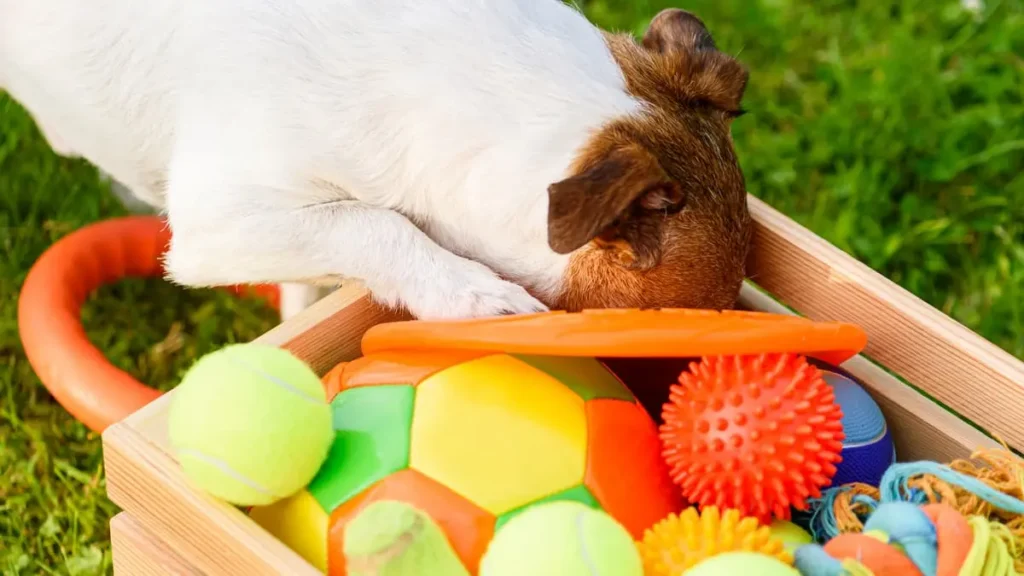
I love coming across articles like these. There is something deeply validating about seeing science catch up to what many of us have felt in our hearts (and our living rooms) for years. Recent studies published in the journal Science have confirmed that certain “gifted” dogs possess a vocabulary-building skill that puts them functionally on par with 18-month-old toddlers.
These canine prodigies aren’t just following hand signals or responding to a specific tone of voice. They are performing a feat called label learning—the ability to understand that a specific sound (a word) refers to a specific object.
The most fascinating part of this research, led by Dr. Shany Dror, is how these dogs acquire new words. Researchers found that these gifted dogs can learn the name of a new toy simply by overhearing two humans talk about it.
In the study, owners would chat with another human about a new toy—using sentences like “This is a stingray”—without ever looking at or addressing the dog. Days later, when asked to retrieve the “stingray” from a pile of other toys, these dogs succeeded approximately 80% of the time.
They even showed an incredible ability to learn when the toy was out of sight. If an owner put a new toy in a bucket and then talked about it while glancing at the bucket, the dogs could still make the connection. This shows a sophisticated level of social communication; they are tracking our attention and following our gaze to understand our perspective.
The Intellectual Gap
It is no surprise to me that many of these “super-learners” are herding breeds, particularly Border collies. Take Basket, a border collie from Manhattan who knows the names of over 150 toys. Her owner, Elle, noted that there never seemed to be a limit to what Basket could learn.
However, the study also highlighted a “control group” of typical Border collies that did not show these same abilities. While “genius” dogs can learn through the process of elimination—inferring that a new word must belong to a new, unfamiliar toy—most “regular” pets don’t seem to pick up labels from overheard speech in the same way.
Bridging the Intuitive Divide
As a veterinarian and communicator, this “gap” is where my curiosity truly lives. In my sessions, I often encounter a deep intellect and a profound level of understanding that transcends simple vocabulary.
If science shows that some dogs are “eavesdropping” on our grocery lists and toy descriptions, it makes me wonder about the dogs who don’t pass these specific tests. Is it a lack of interest in “labels,” or are they tuned into a different frequency of communication?
The study suggests that gifted dogs are more focused on novel objects and exhibit better self-control. But for the dogs who aren’t “label learners,” the disconnect between their deep internal life and their ability to fetch a “stingray” remains a beautiful mystery left to be explored. It reminds us that while language is a bridge, the emotional bond and social cues we share are the foundation that language “hitchhiked” upon in the first place.
Links to articles:
We will always include links to the original articles Dr. Lauren discovered and sadly, some of those articles will require a subscription. Dr Lauren’s subscriptions can’t be extended to others, even though we would love to share.
https://www.nytimes.com/2026/01/08/science/dogs-research-vocabulary-toys.html
https://www.npr.org/2026/01/08/nx-s1-5667604/genius-dogs-learn-new-words-eavesdropping